Which documents to request from a contractor or subcontractor
Updated on 29 October 2026 · This guide is for information only and does not replace advice from your health and safety prevention service.
There is no single list imposed by law: the documents you request from a contractor depend on the activity, the risks and what you agree. But there is a core that almost every company asks for, because it comes straight from Spanish regulations. This is the usual list, grouped by company, worker and machine as a CAE platform organises it, with the regulation behind each document and how often it has to be renewed.
Summary: document, regulation and validity
| Document | For | Regulation | Usual validity |
|---|---|---|---|
| Risk assessment and prevention planning | Company | RD 171/2004, art. 10 | Until the work or the risks change |
| Prevention organisation model | Company | Law 31/1995, art. 30 onwards | That of the current agreement or organisation |
| AEAT certificate for contractors (tax compliance) | Company | Law 58/2003, art. 43.1.f | 12 months from issue |
| Social security compliance certificate | Company | Workers’ Statute, art. 42 | No legal period: requested again regularly |
| RNT (monthly social security list of workers) | Company | Monthly social security contributions | Monthly (the last settled month) |
| Public liability insurance | Company | Contract or internal procedure | That of the policy and its receipt |
| REA registration (construction) | Company | Law 32/2006, art. 6, and RD 1109/2007 | 3 years, renewable |
| Social security registration | Worker | Affiliation and registration | Once, while they stay with the company |
| Job-specific health and safety training | Worker | Law 31/1995, art. 19 | Repeated when the job or the risks change |
| Risk information | Worker | Law 31/1995, art. 18 | Once per job and when the risks change |
| Medical fitness | Worker | Law 31/1995, art. 22 | According to the protocol; usually yearly |
| PPE handover | Worker | RD 773/1997 | At each handover or replacement |
| CE marking or compliance upgrade | Machine | RD 1644/2008 (machinery) or RD 1215/1997 | Once per machine |
| Maintenance and inspections | Machine | RD 1215/1997 and the manufacturer’s manual | According to the maintenance plan |
| MOT (ITV) and insurance | Road vehicle or machine | Traffic regulations | According to the inspection and the policy |
Validity periods are a guide: your prevention service or your procedure may require shorter ones.
Company documents
- Risk assessment and prevention planning for the contracted work. The main company must require it in writing before work starts (RD 171/2004, art. 10).
- Prevention organisation model: the employer taking it on personally, designated workers, or an in-house, external or joint prevention service (Law 31/1995, arts. 30 to 32, and RD 39/1997, art. 10).
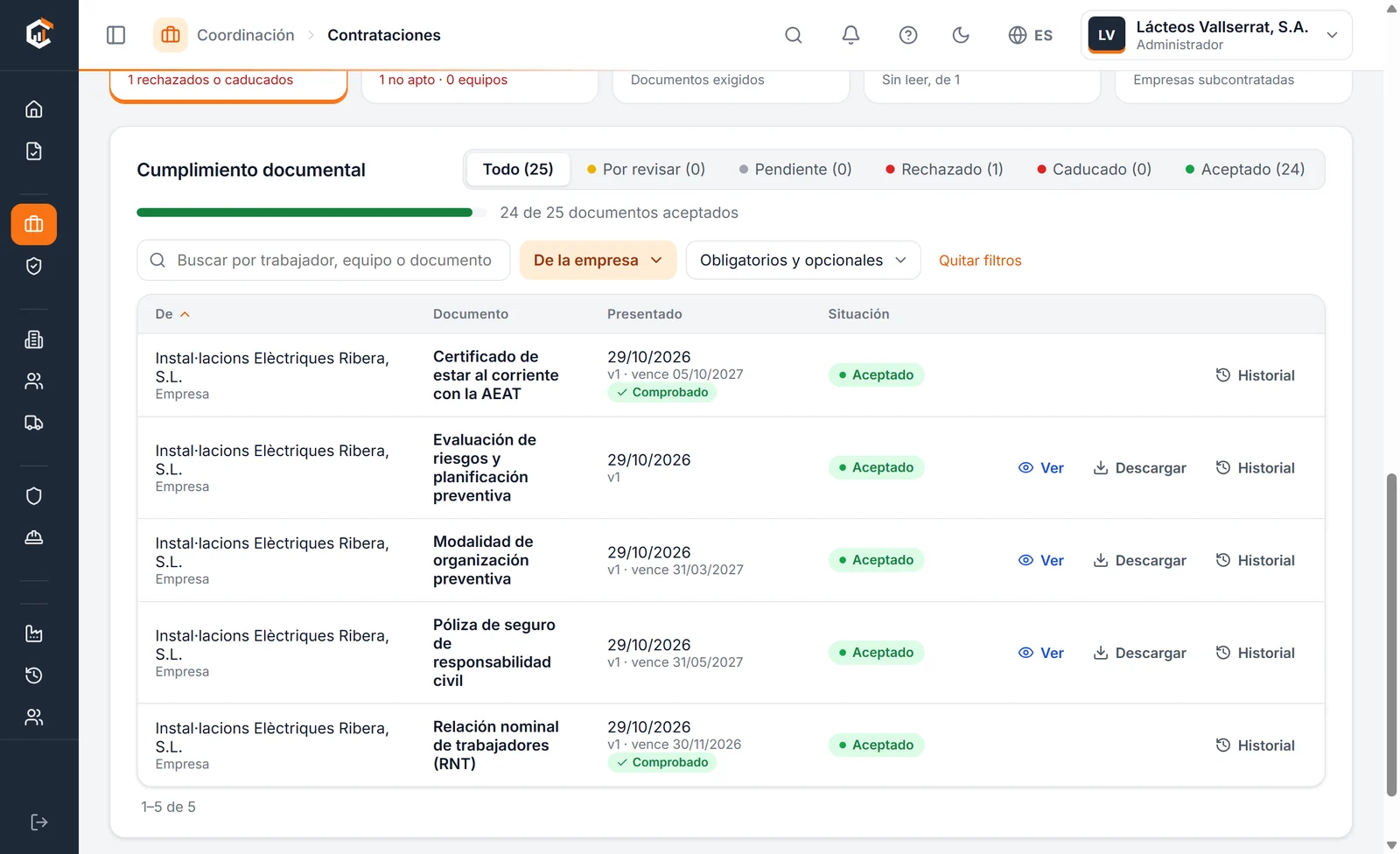
- AEAT tax compliance certificate (the specific one for contractors and subcontractors). It protects you from secondary liability for the contractor’s tax debts linked to the contracted work (General Tax Law, art. 43.1.f). It is requested from the Tax Agency’s online office. Coorvia validates it automatically: it checks the tax ID, the client, that it is positive and that it is valid, and stores only that data.
- Social security compliance certificate, because of the main company’s joint liability for the contractor’s contributions (Workers’ Statute, art. 42). It is obtained from Import@ss.
- RNT (relación nominal de trabajadores) for the last settled month, which shows who contributions were paid for. Coorvia validates it automatically: it reads the period and who is on it, matches it against the assigned workers and does not keep the file.
- Public liability insurance and proof of payment.
- In construction: registration in the Register of Accredited Companies (REA) (Law 32/2006).
Documents for each worker
- Social security registration (for example, the affiliation data report). It only needs to be submitted once while the worker stays with the company; each month’s contributions are shown by the company’s RNT.
- Health and safety training for the job (Law 31/1995, art. 19) and, where applicable, specific training: work at height, forklifts, mobile elevating work platforms, confined spaces, electrical risk…
- Risk information given to the worker (Law 31/1995, art. 18).
- Medical fitness: the certificate stating the worker is fit for the job (Law 31/1995, art. 22). Never medical reports or diagnoses: they are health data and are not needed for coordination.
- Personal protective equipment (PPE) handover (RD 773/1997).
- Authorisations to use equipment when regulations or the internal procedure require them.
- In construction: the training required by the sector agreement and, where applicable, the Construction Professional Card (TPC).
Documents for each machine
- CE marking and declaration of conformity (RD 1644/2008 for machinery), or upgrade to RD 1215/1997 for older equipment.
- Instruction manual and maintenance and inspection log.
- MOT (ITV) and insurance for vehicles and machinery used on the road.
What should you not request?
The obligations behind this list are in Royal Decree 171/2004 explained, and if you are looking for a tool to manage it, see how to choose a CAE platform.
Asking for too much is also a problem: it slows down the contractor’s onboarding and can clash with data protection. There is no need to ask for medical reports, full payslips, copies of ID cards when the number is enough, or employment contracts. If a document does not help check that the work is done safely or that the contractor is up to date with its obligations, it is probably unnecessary.
How often should the documents be renewed?
Each document has its own validity: the AEAT certificate for contractors lasts 12 months, the social security one is best renewed more often, the RNT is monthly, medical fitness is usually yearly, insurance expires with the policy and training has its own deadlines. The hard part is not requesting them once but keeping them up to date and knowing at any moment who can enter.
That is what a platform is for: in Coorvia you set the requirements for each contract (including validity days if you want them renewed before they expire), the contractor submits them once for all its clients, without paying anything, and on each contract you see who can enter today and why not. If you are the contractor, see how Coorvia works for suppliers.
Frequently asked questions about CAE documents
Which documents are mandatory for a contractor?
Under Royal Decree 171/2004, the main company must require in writing the risk assessment and prevention planning for the contracted work, and proof that the workers have received information and training. The rest of the usual list (compliance certificates, RNT, medical fitness, PPE, insurance) protects the main company from liability or comes from other regulations.
How long is the AEAT certificate for contractors valid?
The tax compliance certificate for contractors and subcontractors covers payments made in the 12 months after it is issued, under article 43.1.f of the General Tax Law. After that, a new one has to be requested.
What is the RNT and why is it requested from a contractor?
The RNT (relación nominal de trabajadores, formerly TC2) is the monthly social security document showing which workers the company paid contributions for. It is requested to check that the contractor paid contributions, in the last settled month, for the workers entering your workplace; later starters are shown with their social security registration.
Can I request the medical check-up of the contractor’s workers?
Neither the check-up nor any health data. What is requested is the fitness certificate (fit or unfit for the job), which is all that is needed for coordination and reveals no medical information.
Sources
- Royal Decree 171/2004 and Law 31/1995 on the Prevention of Occupational Risks (BOE, in Spanish).
- Law 58/2003, General Tax Law and Workers’ Statute (BOE, in Spanish).
- RD 773/1997 (PPE), RD 1215/1997 (work equipment) and Law 32/2006 (subcontracting in construction) (BOE, in Spanish).
Written by the Coorvia team from the consolidated text in the BOE (Spain’s Official State Gazette) cited in the sources. If you find a mistake or something has changed, write to us at hola@coorvia.app and we will fix it. How we write our guides.