What is CAE and when is it mandatory
Updated on 29 October 2026 · This guide is for information only and does not replace advice from your health and safety prevention service.
Business activity coordination (CAE, coordinación de actividades empresariales) is the set of measures that companies must take in Spain when their workers share the same workplace, so that the risks of one do not affect the workers of the others. It is required by article 24 of Law 31/1995 on the Prevention of Occupational Risks and developed by Royal Decree 171/2004, which sets out who has to do what.
When is CAE mandatory?
CAE is mandatory whenever workers from two or more companies or self-employed workers carry out activities in the same workplace. There does not need to be a contract between them, nor do they need to be there at the same time: it is enough that one company’s activity can affect another’s workers. Some common examples:
- A factory that brings in a maintenance or installation company.
- An office building with outsourced cleaning and security.
- A construction site with several subcontractors and self-employed workers.
- A warehouse or logistics hub with hauliers loading and unloading.
- A hospital, hotel or shopping centre with external catering, gardening or security services.
Royal Decree 171/2004 defines a workplace very broadly: any area, built on or not, where workers must stay or which they must access because of their work. A car park, a roof or a plot under construction also count.
What coordination is for
Article 3 of Royal Decree 171/2004 sets four objectives:
- Apply the principles of preventive action consistently and responsibly in every company present.
- Apply each company’s working methods correctly.
- Control the interactions between the different activities, especially when they create serious or very serious risks or become worse when they coincide.
- Match the existing risks in the workplace with the preventive measures applied.
The three roles in CAE
Obligations depend on each company’s role in the workplace. One company can have several roles at once: owner of its own plant, main company for its contractors and, on another site, contractor of another company.
| Role | Who it is | What it must do | Articles |
|---|---|---|---|
| Concurrent company | Any company or self-employed worker with workers in the workplace. | Cooperate: inform the others of the risks of its activity, report emergencies and accidents, and pass the information on to its workers. | Arts. 4, 5 and 9 |
| Owner of the workplace | Whoever has the power to make the workplace available and manage it. | As well as cooperating, inform of the workplace’s own risks and emergency measures, and give instructions to the other companies. | Arts. 6, 7 and 8 |
| Main company | Whoever contracts or subcontracts works or services within its own business activity that are carried out at its workplace. | As well as the above, monitor that its contractors and subcontractors comply with health and safety and require from them, in writing, their risk assessment and the training and information of their workers. | Art. 10 |
We go through it point by point in Royal Decree 171/2004 explained.
What is exchanged in practice
Coordination mostly means documents and information going back and forth before the work starts and while it lasts:
- From the contractor to the main company: risk assessment and activity planning, evidence of workers’ training and information, medical fitness, PPE handover, insurance, tax and social security compliance certificates and the RNT (the monthly social security list of workers). The full list, with the regulation and validity of each document, is in which documents to request from a contractor.
- From the owner to the contractors: workplace risks, access rules, emergency measures and instructions, in writing when the risks are serious or very serious.
- Between all companies: messages when the work or the risks change and, immediately, when there is an accident or an emergency.
Means of coordination
The law does not impose a single method: each workplace chooses the means that best fit the hazards of the activities, the number of workers and how long the work lasts. Article 11 lists, as an open list:
- Exchanging information and messages between companies.
- Regular meetings between the concurrent companies.
- Joint meetings of the health and safety committees or, if there is no committee, of the employers with the prevention delegates.
- Instructions from the owner of the workplace.
- Specific measures, procedures or joint action protocols.
- The presence in the workplace of the companies’ preventive resources.
- Appointing one or more people in charge of coordination.
A person in charge of coordination is the preferred means when two or more of these circumstances apply (art. 13): a company carries out hazardous activities or activities with special risks; it is especially difficult to control interactions that create serious or very serious risks; it is especially difficult to avoid incompatible work; or coordination is especially complex because of the number of companies and workers, the type of activities or the workplace itself. That person needs at least intermediate-level training in occupational risk prevention.
CAE on construction sites
On construction sites, Royal Decree 171/2004 applies together with Royal Decree 1627/1997 (health and safety coordinator, safety plan) and Law 32/2006 on subcontracting in the construction sector, which adds registration in the Register of Accredited Companies (REA), limits on the subcontracting chain and the subcontracting book.
What happens if there is no coordination
Failing to adopt cooperation and coordination measures is a serious offence (art. 12.13 of the Spanish Social Order Offences and Penalties Act, LISOS), with fines from €2,451 to €49,180, and a very serious one (art. 13.7) for hazardous activities or activities with special risks, with fines from €49,181 to €983,736. In addition, the main company is jointly liable for breaches by its contractors and subcontractors within its own business activity during the contract when the offence occurs at its workplace. The details are in the Royal Decree 171/2004 guide.
The problem: paper, emails and spreadsheets
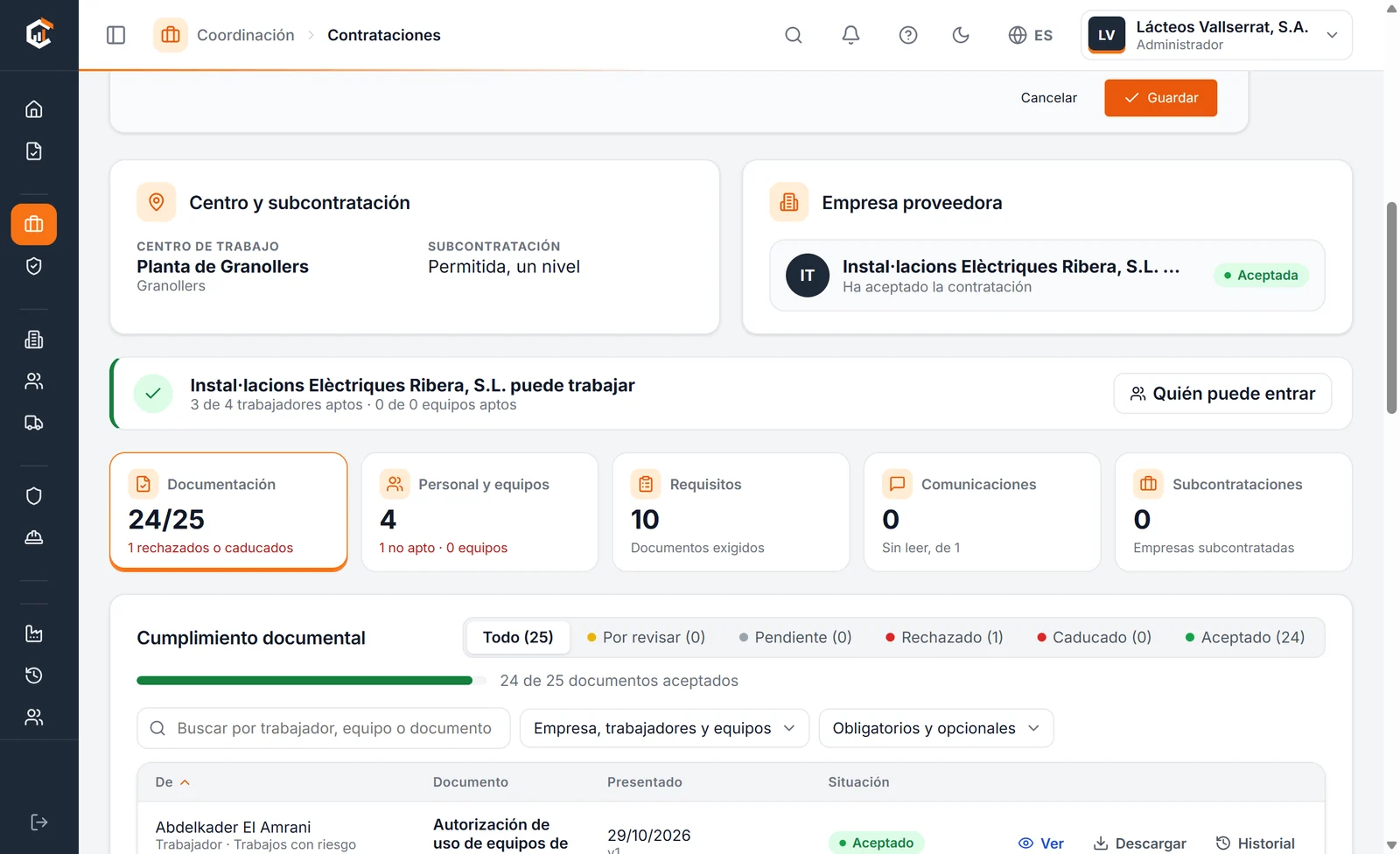
With a few contractors it can be done by hand, but as they grow the usual problems appear: expired documents nobody notices, workers entering without up-to-date training, emails with attachments impossible to find and no organised proof of what was requested and reviewed. That is why many companies use a CAE platform (we explain how to choose one), which requests the documents, sends reminders before they expire and keeps a record of every step. If you are worried about the cost for your suppliers, see why a CAE platform can be free for contractors.
Frequently asked questions about CAE
Is CAE mandatory if only a self-employed worker comes in?
Yes. Business activity coordination also applies to self-employed workers working in the workplace: they must cooperate and report their risks, and whoever hires them must inform them of the workplace’s risks and, if the work is within its own business activity, monitor that they comply.
Is coordination needed if the companies are not there at the same time?
Yes, if one company’s activity can affect another’s workers: for example, night cleaning that leaves the floor wet or maintenance that leaves a machine without its guard. What counts is sharing the workplace, not exactly overlapping hours.
Who is responsible for CAE in a workplace?
Every company present has obligations. The owner of the workplace takes the lead in setting the means of coordination when its own workers work there; otherwise the main company does (art. 12 of Royal Decree 171/2004).
Is CAE the same as occupational health and safety (PRL)?
No. Occupational risk prevention (PRL) is each company’s obligation towards its own workers. Business activity coordination is part of it: the part that deals with the risks that appear when several companies work in the same place.
Sources
- Law 31/1995 on the Prevention of Occupational Risks (BOE, consolidated text, in Spanish).
- Royal Decree 171/2004 on business activity coordination (BOE, in Spanish).
- Social Order Offences and Penalties Act (LISOS) (BOE, in Spanish).
- Guidelines for effective business activity coordination (INSST, 2024), in Spanish.
Written by the Coorvia team from the consolidated text in the BOE (Spain’s Official State Gazette) and the INSST guidelines cited in the sources. If you find a mistake or something has changed, write to us at hola@coorvia.app and we will fix it. How we write our guides.